About the artist
1937–2008
Born in what was then Czechoslovakia and working in Sweden from 1968, in both theatre and visual art.
Biography
A life between theatre and visual art
Vladimir Puhony was an artist and stage designer, born in what was then Czechoslovakia. After the Soviet invasion in 1968 he was forced to leave his homeland and settled in Sweden, where he went on to build a long and significant career in both theatre and visual art.
He studied at the Academy of Arts, Architecture and Design in Prague, where he took his master's degree in 1959, specialising in monumental painting. He then continued his studies at the Academy of Performing Arts in Prague and in 1963 took a second master's degree, this time in scenography. In the years up to 1968 he worked as a stage designer at several Czech theatres, while also active as an illustrator and artist.
When Vladimir arrived in Sweden he was employed at Malmö Stadsteater, where his first stage design premiered in January 1969. It was the beginning of an intense and successful working life in Swedish theatre. Over the following ten years he created sets and costumes for a large number of productions. Among the most noted were “…and they put handcuffs on the flowers” by Fernando Arrabal, “Röde Orm” and “Hamlet”.
His work was greatly appreciated and received many good reviews. At the same time he worked as a freelance stage designer for theatres around Sweden, including in Uppsala, Helsingborg, Norrköping, Gävle and Borås, and also abroad in Norway, Finland and Germany. In 1977 he was offered the post of head teacher of scenography at Dramatiska Institutet in Stockholm. Training the next generation of Swedish stage designers became an important and inspiring task, while he continued his extensive work in the theatre.
Despite a demanding professional life, painting was always a natural and necessary part of Vladimir's life. Colours, brushes and canvases were his great passion. He spent every spare moment in his studio, where he could give form to the images and ideas that kept growing within him. Painting became a place for reflection and creative joy, a counterweight to the intense pace of the theatre.
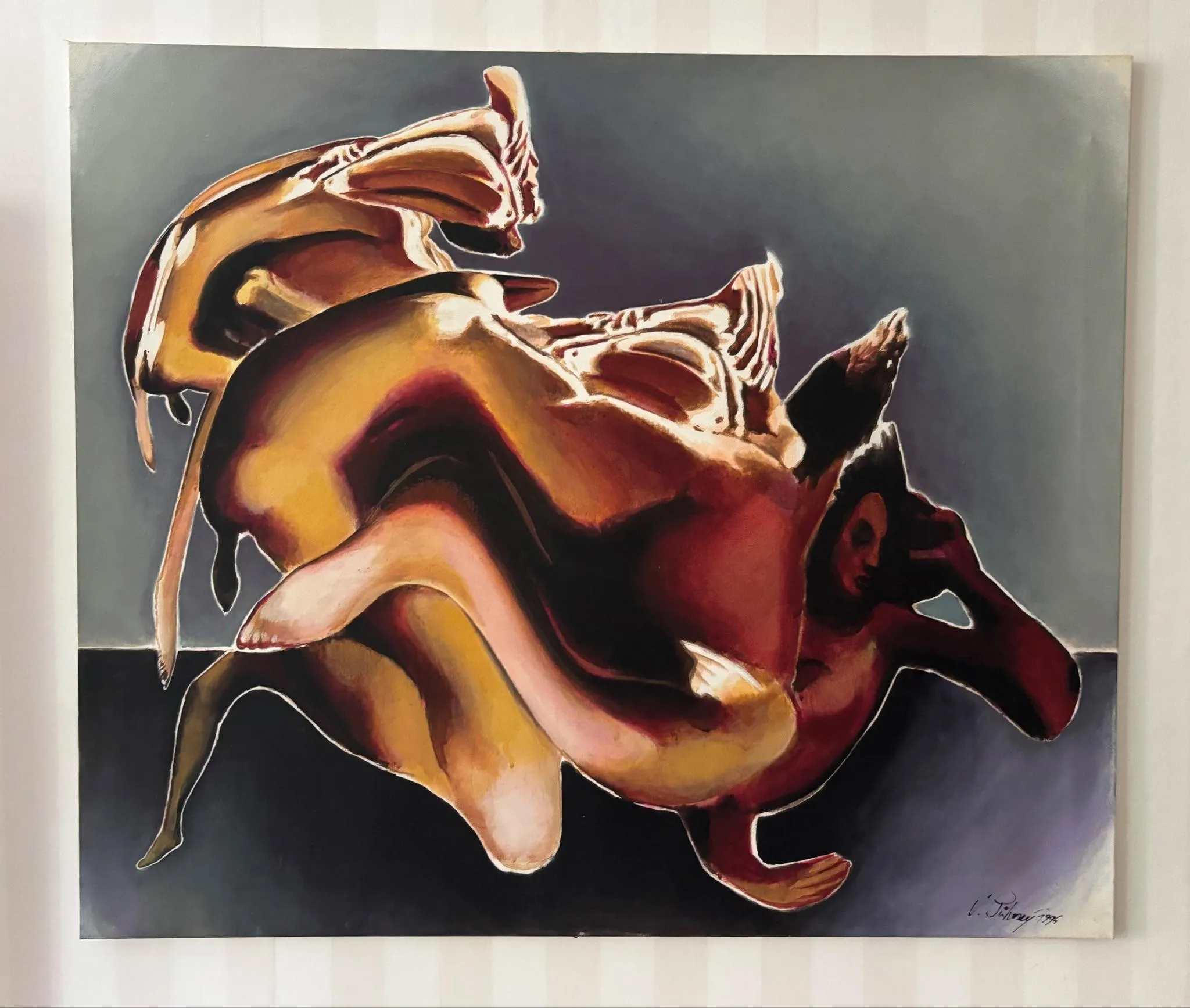
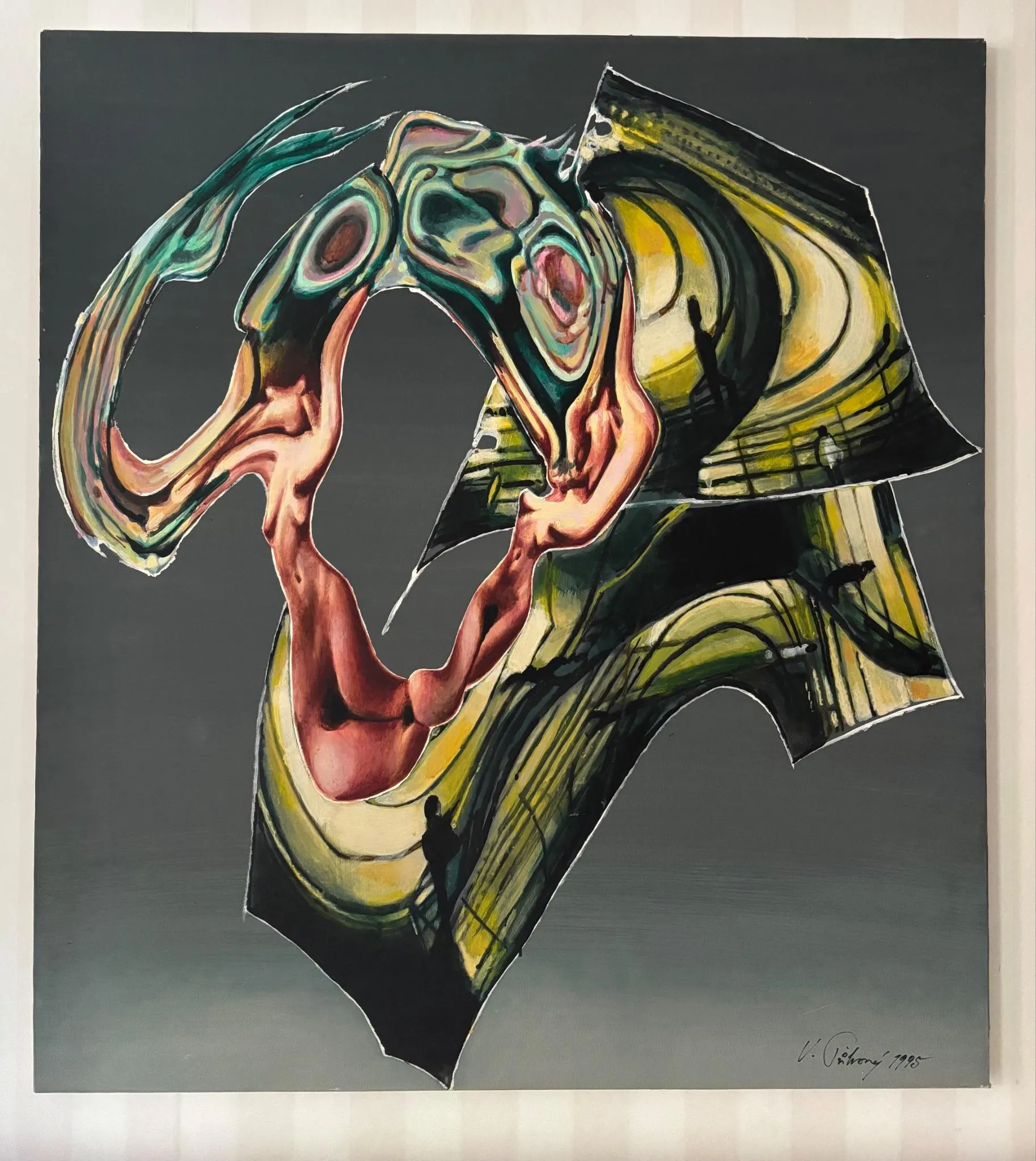
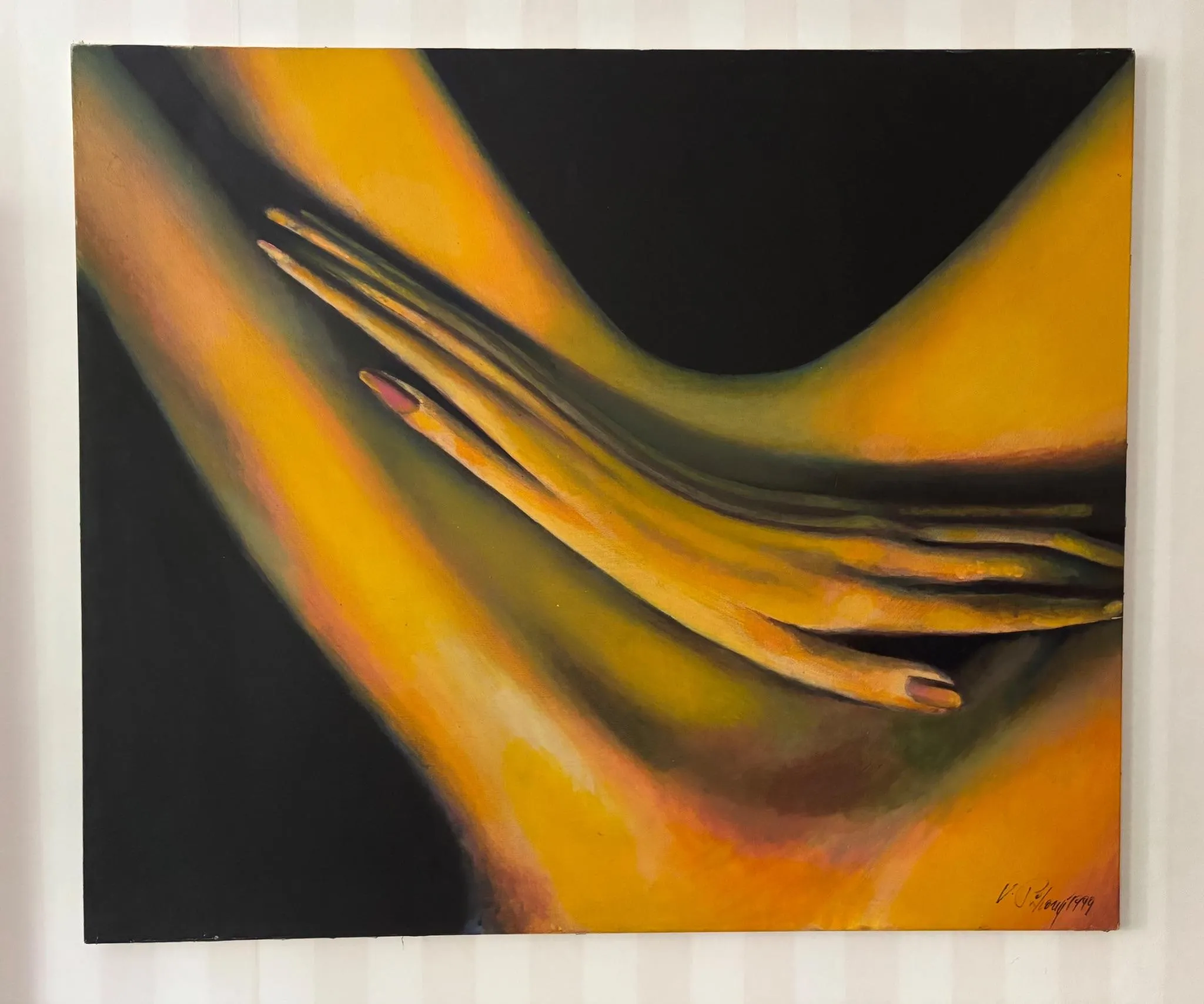
In time, his experience of the stage came to shape his imagery. Space, light, movement and the human figure became recurring themes. In the early paintings he drew inspiration from the forms, structures and play of light in nature. Later the human body came to stand at the centre. His figures are rarely naturalistic; proportions shift. A leg becomes unexpectedly long, a strand of hair sweeps across the landscape, or two women meet in the same figure. What mattered was not to depict reality, but to capture movement and the fleeting moment that exists only for a short while.
Vladimir was never particularly concerned with exhibiting his work. For him, the act of creating was what mattered most. He painted on canvas, board, plywood and wood panels, whatever material was at hand when a new idea wanted to become real. What mattered was that the picture was allowed to come into being.
During his lifetime he exhibited in Sigtuna, Malmö, Vaasa, the USA and Prague, among other places. The largest exhibition was held in Prague in 2004 and showed around 40 large paintings. Today the collection of Vladimir Puhony comprises over 200 works, painted between 1968 and 2007 in acrylic and tempera on canvas and board. In 2009 a major memorial exhibition was shown at the Czech Centre in Stockholm, where his art once again met a wide audience.
Vladimir Puhony's art bears traces of a life marked by creation, movement and change. Through both stage design and painting he left behind a rich artistic legacy, in which every work tells something about people, movement and the inner world.
Background
Upbringing
Vladimir Puhony was born and grew up in what was then Czechoslovakia. After the Soviet invasion in 1968 he was forced to leave his homeland and settled in Sweden.
Education, 1959
Master's degree from the Academy of Arts, Architecture and Design in Prague, specialising in monumental painting.
Education, 1963
Master's degree from the Academy of Performing Arts in Prague, specialising in scenography.
After his studies
He worked as a stage designer at several Czech theatres, and as an illustrator and artist.
A life in stage design and painting
1937Born in Czechoslovakia
Vladimir Puhony is born in Czechoslovakia.
1959Master's degree in monumental painting
Graduates with a master's degree from the Academy of Arts, Architecture and Design in Prague.
1963Master's degree in scenography
Takes a second master's degree, in scenography, at the Academy of Performing Arts in Prague.
1968The move to Sweden
Leaves Czechoslovakia after the Soviet invasion and moves to Sweden.
1969Malmö Stadsteater
Begins work at Malmö Stadsteater; his first Swedish stage design premieres.
1977Head teacher of scenography
Becomes head teacher of scenography at Dramatiska Institutet in Stockholm.
2004Solo exhibition in Prague
A major solo exhibition in Prague with around 40 large paintings.
2008Death
Vladimir Puhony dies.
2009Memorial exhibition
Memorial exhibition at the Czech Centre in Stockholm.
See the paintings
The paintings in the catalogue are presented with title, year, dimensions and technique.
See the works